

| For Questions and Information, please send
us an email.
|
What is Lymphoma?
Lymphomas are cancers arising from lymphocytes, which are a fundamental part of the immune system and which help to protect the body from disease. Lymphomas include Hodgkin's Disease and various classifications and sub-types of non-Hodgkin's lymphomas. In addition to a network of lymph vessels and nodes throughout the body, the lymphatic system also includes the bone marrow, spleen, thymus gland, tonsil, and appendix. Lymphoma is the fifth most common form of cancer in Canada. An estimated 7,890 new cases of lymphoma have been diagnosed in Canada in 2008. Lymphomas now account for approximately 5% of all Canadians with cancer. There are two primary forms of lymphoma. Hodgkin's Disease accounts for about 11% of all Canadian lymphomas and is generally considered one of the more curable cancers. Non-Hodgkin's lymphomas are more prevalent and their cure rates depend on the type or sub-type, the stage, the grade and various prognostic factors. There are more than 30 types and sub-types of Non-Hodgkin's lymphomas. The incidence of the more prevalent forms of lymphoma, non-Hodgkin's lymphomas, has increased significantly over the past several decades in Canada. The incidence of Non-Hodgkin's lymphoma in both males and females has stabilized. Until recently, Non-Hodgkin's lymphoma seemed to develop more frequently as people got older, but there has been a marked increase of Non-Hodgkin's lymphoma in children and young adults. Non-Hodgkin's lymphoma is complex in that there are many different classifications, as well as sub-types and stages of Non-Hodgkin's lymphoma, each with varying treatment options and cure rates. One current hypothesis is that Non-Hodgkin's lymphoma is actually a group of closely related cancers, in which infectious agents and/ or environmental/ occupational exposures may play a role. Some of the challenges of living with lymphomas may include their unpredictability and their recurrence. 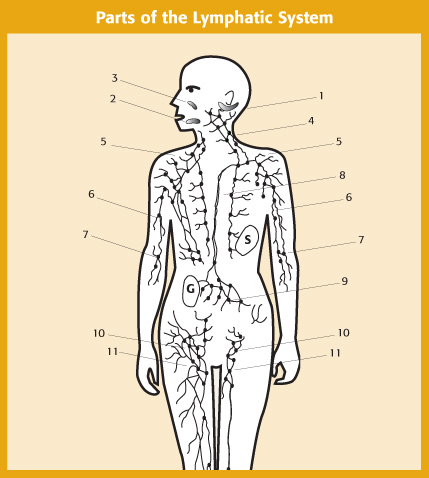 This diagram represents where key lymph nodes are situated throughout the human body. It has been estimated that there are about 600 lymph nodes in the body. The numbers in the diagram denote areas of lymph nodes that frequently are involved in Hodgkin and other lymphomas. These areas of lymph nodes occur around the ears (1) and around the jaw (2). They comprise the tonsils and adenoids (3), are found in the front and back of the neck (4), above and below the collar bone (5), in the armpit (6), near the elbow (7), in the chest (8), in the abdomen (9), in the pelvis (10) and in the groin (11). The spleen (S) contains many clusters of lymphocytes. These clusters may be involved in the malignant process, grow, and lead to involvement and enlargement of the spleen. The gut-associated (intestinal) lymph tissue (G) may also be the site of lymphoma development. Lymphomas are cancers that begin with the malignant transformation of a lymphocyte in the lymphatic system. "Lymph-" indicates that the disease begins in a lymphocyte and "-oma" is a Greek suffix denoting a tumor.   Symptoms
The symptoms of lymphoma are commonly seen in other, less serious illnesses, such as influenza or other viral infection. These symptoms are often overlooked, but in cases of less serious illnesses they would not last very long. With lymphoma, these symptoms persist over time and cannot be explained by an infection or another disease. The checklist below lists the most common symptoms of lymphoma. Due to the common nature of these symptoms and because lymphoma symptoms do not appear in all cases, diagnosis is often problematic. If you suspect that you, a family member, friend, or loved one may have lymphoma, see your doctor or qualified medical professional as soon as possible. Early diagnosis makes an impact on treatment and outcome. The most common symptoms of lymphoma are:
Because of the common nature of these symptoms and because lymphoma symptoms do not appear in all cases, diagnosis is often problematic. Symptoms of more advanced lymphoma may
include the following:
|